Can You Trust AI With Money? Why It Gets Numbers Wrong
You can trust AI with money only if it never does the math from memory. Language models predict text, so they can state a wrong total with confidence. The fix is structure: answer only from a verified ledger, run real look-ups, and say "Not in your data" when the data is missing.
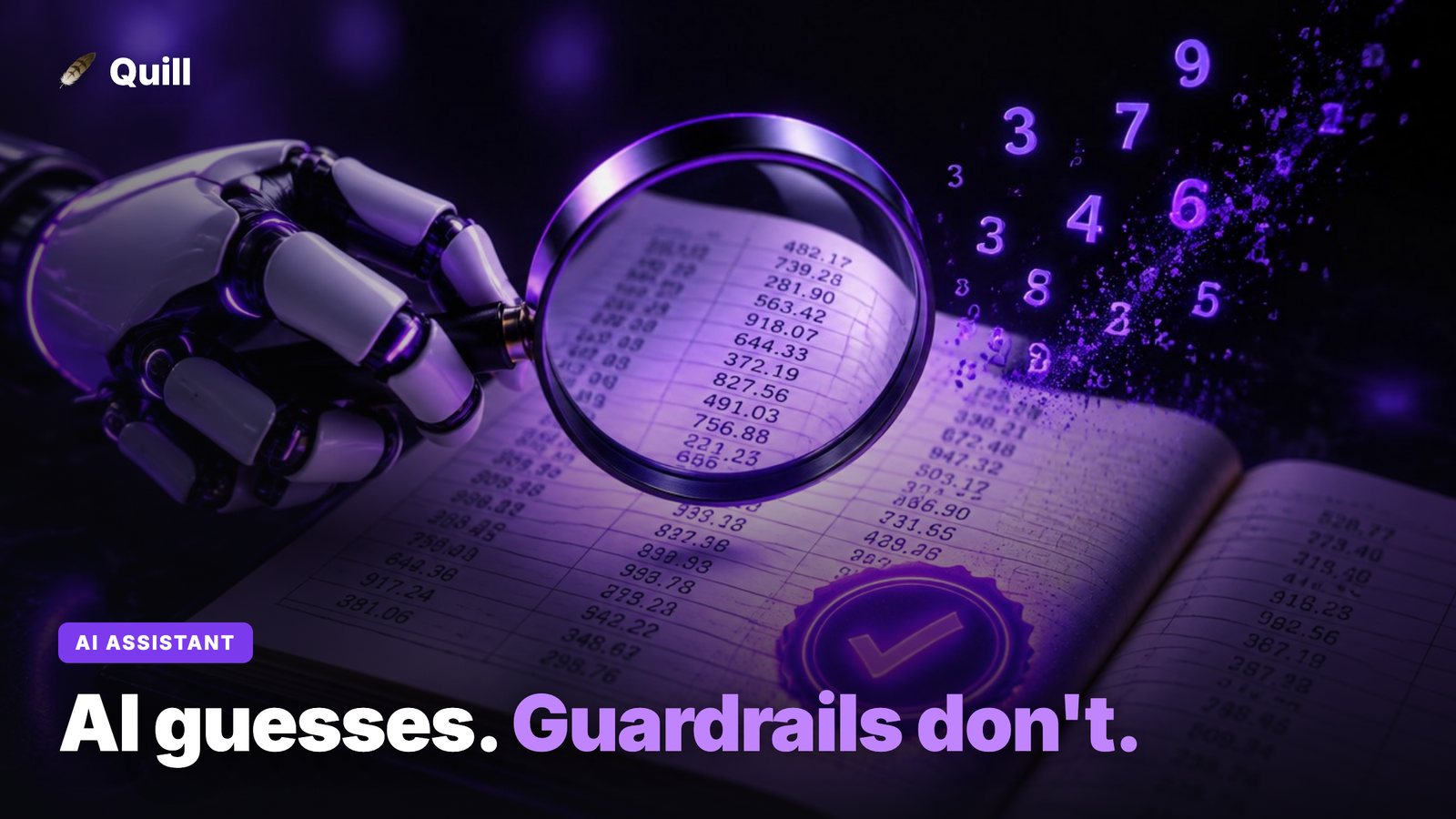
Ask a chatbot "how much did I spend on food last year?" and you will get a smooth, confident answer. Whether it is right is another matter. This post explains why AI gets money figures wrong, and the design choices that make an AI financial assistant dependable. The full picture of what a good one does is in An AI Financial Assistant That Does the Work, Not Just the Talking.
Why does AI get money numbers wrong?
AI gets money numbers wrong because a language model writes the most likely next words. It is not a calculator and not a database.
Three habits cause most of the damage:
- It predicts text, not totals. Adding forty charges "in its head" is a guess that looks like arithmetic. Most of the time it is close. Sometimes it is not, and the answer reads the same either way.
- It rebuilds your numbers every time. In a blank chat, you upload a file and the model reads it fresh. A column misread, a page skipped or a row merged changes the result, and nothing tells you.
- It fills gaps. If a month of statements is missing, a model may quietly treat it as zero, or invent a plausible figure, because an answer feels better than "I cannot tell."
This is why general chatbots struggle with money. It is not a lack of intelligence. It is a lack of structure around the intelligence.
What does a guardrail actually look like?
A guardrail is a rule built into the system that the AI cannot talk its way around. Six of them matter most.
| Failure | Guardrail |
|---|---|
| Wrong source numbers | Answer only from statements already proved against the bank's printed totals |
| Mental arithmetic | Run a real look-up on the data instead of calculating in text |
| Made-up answers | Say "Not in your data" when the data cannot answer |
| Missing months read as zero | Never treat missing data as zero; flag the gap |
| Assumed interest rates | Ask for an unknown rate; never rank a debt without it |
| Unverifiable answers | Show the exact rows behind the answer |
How do you make the numbers right before the AI sees them?
You prove the data first. An AI that works from unchecked data can only be as right as that data.
Quill reads each bank statement on your computer and checks it against the totals the bank printed on it, to the cent. A statement that does not add up is flagged, never silently counted. By the time the assistant is asked anything, the figures it works from have already passed that test. If you want to see how that works for a single statement, Chat With Your Bank Statements walks through it.
Why are real look-ups better than mental math?
A look-up asks the data a precise question and returns the exact rows, so there is nothing for the model to estimate.
Quill gives its assistant a fixed set of actions. Fifteen of them are look-ups that run straight away and change nothing: find charges by words, dates or amounts, money in and out, spending by category, month-by-month trends, subscriptions, debts and more. When you ask "what did I spend at the pharmacy in March," the assistant runs a search and reports what came back. It does not reconstruct the answer from memory.
It is the same reason you would rather ask a spreadsheet than a friend who "remembers roughly."
What should an AI do when it does not know?
It should say so. A refusal is more useful than a confident guess.
Two rules cover most of it. First, if the data cannot answer the question, the assistant says "Not in your data." Second, missing data is never treated as zero. If a statement month is absent, Quill's gap detection flags it, so a "lowest spending month" is never just the month you forgot to import.
Debt is the clearest case. If the assistant does not know a card's interest rate, it will not rank that debt or guess a rate. It leaves that debt out of the plan and asks you. A plan built on an invented rate is worse than no plan. See how this plays out in Lump Sum to Pay Off Debt: Which Debts Go First?
How can you check an AI's answer yourself?
You check it against the rows. A trustworthy assistant makes that a one-click step.
When Quill's assistant finds charges, a "Show me" button opens the ledger with exactly those rows highlighted. You do not have to take the total on faith. You can scroll the charges, spot a duplicate, or open the original PDF.
The same principle applies to changes. The assistant can propose things like a category for a merchant or a new rule. Every proposal says how many charges and how much money it touches, and shows "Nothing has happened yet." Only your click applies it, and Quill saves a safety backup first. It cannot delete statements or transactions, move money, pay bills or cancel subscriptions.
What are the honest limits?
Guardrails reduce errors. They do not make an AI a financial advisor.
- The assistant is not a licensed advisor, does not recommend investments, and does not say what is tax-deductible.
- It is a cloud AI. When you ask it something, a summary of your finances and any charges it looks up go to the AI provider you picked. Switch AI off and none of that happens. Your PDF statement files are never uploaded.
- It can still misread a question. That is why every answer can be checked against the exact rows.
It can run on an AI you already pay for. See Use Your ChatGPT or Claude Plan to Run Your Finances.
So, can you trust AI with money?
Yes, for the right jobs and with the right structure. Trust an AI that works from verified numbers, runs real look-ups, admits what it does not know, and lets you see the evidence. Do not trust one that does arithmetic from memory in a blank chat.
Frequently asked questions
Can you trust AI with your finances?
Trust it for explaining and looking things up, not for unchecked arithmetic. An AI is reliable when it works from figures that were proved against your bank's statements and shows the exact rows behind each answer.
Why does AI get numbers wrong?
A language model predicts the next likely word. It does not run a calculator unless it is given one, and when your files are re-read each chat, small misreadings and gaps turn into confident wrong totals.
What is an AI hallucination in finance?
It is a made-up or wrong figure stated as fact, such as an invented total or a missing month treated as zero. Guardrails reduce it by forcing real look-ups and refusing to guess.
How does Quill stop the assistant from guessing?
Quill proves each statement against the bank's printed totals first. The assistant then answers from that data with look-ups, says "Not in your data" when it cannot answer, and asks for an interest rate it does not know instead of assuming one.
An assistant that shows its receipts
Quill's assistant answers from statements proved to the cent, shows the exact charges, and proposes changes that only apply when you click. It uses the AI you already pay for.
Get Quill