Are AI Agents Safe for Banking? 7 Guardrails to Demand
An AI agent is safe for banking only if its power is capped by design. The seven guardrails to demand: a fixed list of actions, changes that are proposals, a backup first, no delete or money movement, caps on bulk edits, statement text treated as data, and no guessing.
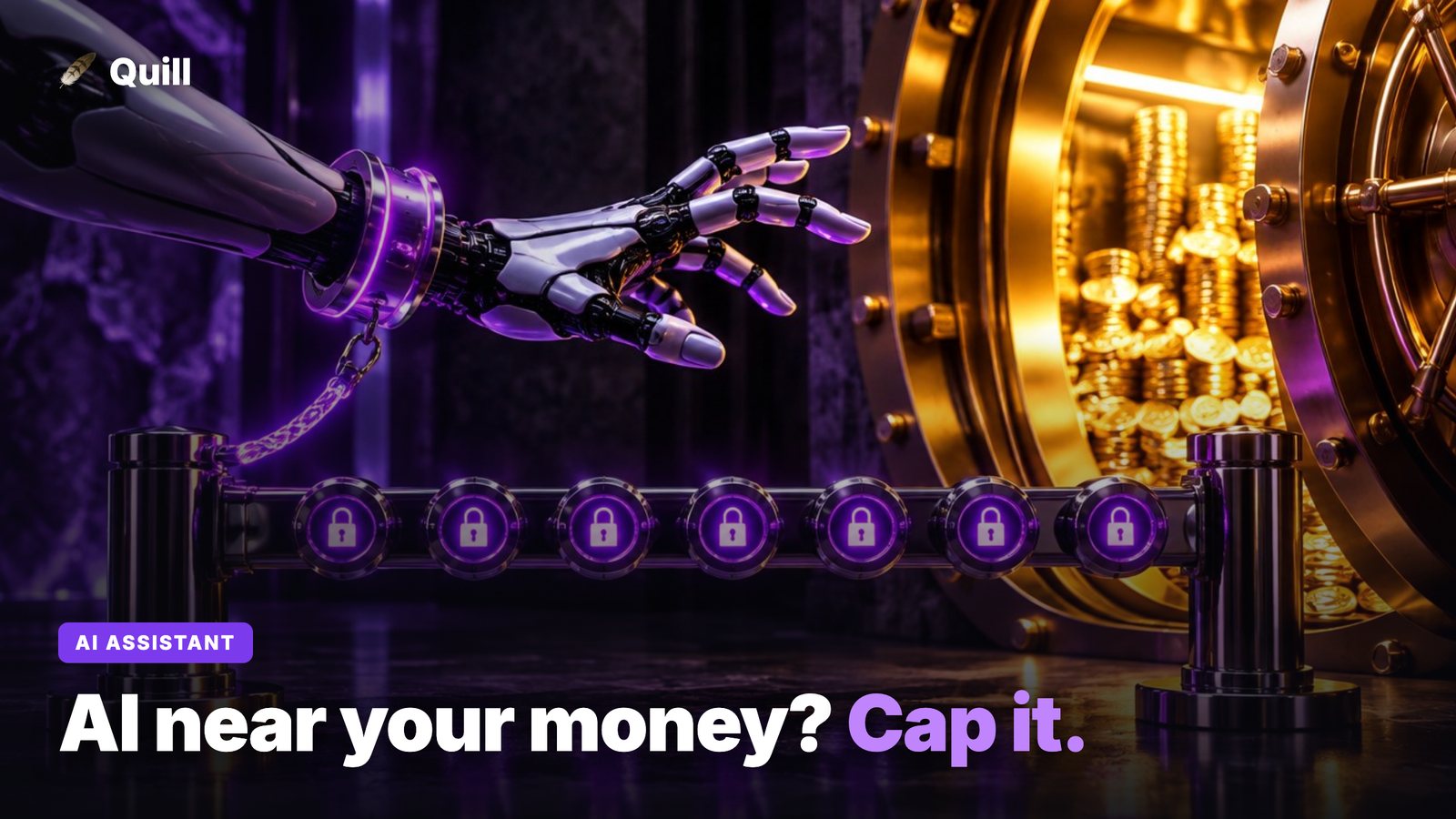
AI agents are getting good at doing things, not just answering. That is useful for money work and risky for the same reason. An agent that can act on your finances can also act wrongly. So the real question is not whether AI is smart enough. It is what the AI is allowed to do. This guide lists seven guardrails to demand from any finance AI, and shows how Quill's AI assistant builds in each one.
What makes an AI agent risky near a bank account?
The risk comes from access plus freedom. An agent with your bank login and a browser can click buttons, fill forms and submit them. If it misreads a page, follows a hidden instruction or simply guesses wrong, the result is real: a wrong transfer, a cancelled account, a deleted record. General chatbots have a different problem. They start from a blank chat and rebuild your numbers each time, so they can be confidently wrong. Our post on why AI gets money numbers wrong goes into that.
A safe design cuts the agent's power down to a short, known list. Here is that list as seven checks.
Guardrail 1: Does the AI have a fixed list of actions?
A safe finance AI can do only what is on a written list, and nothing else. No free browsing, no running arbitrary commands. Quill's assistant works from 44 actions in three kinds: 15 look-ups that change nothing, 15 buttons it can offer for you to press (such as opening a screen or building a report), and 14 changes it can propose. If a request is not on the list, it cannot happen. Quill gives the AI a fixed list of actions and nothing else.
Guardrail 2: Are changes proposals that need your click?
Every change should appear first as a proposal you can read. In Quill, a proposal card says how many charges it touches and how much money, and states "Nothing has happened yet." Only your click applies it. That one rule turns a risky agent into a helper you supervise.
Guardrail 3: Is there a backup before every change?
Even approved changes can be mistakes. Quill saves a safety backup before it applies any change, so you can go back. Ask any tool you try: what is my undo?
Guardrail 4: What can the AI never do?
The most important limits are the things the AI cannot reach at all. Quill's assistant cannot delete statements or transactions, cannot move money, pay bills or cancel subscriptions, and cannot touch your licence, backups, AI settings or folders. A "pay" step in its to do list tells you to pay on your bank's own site. Compare that with an agent holding your bank login, where the only limit is how well it behaves. See is it safe to connect your bank to ChatGPT for what a live connection involves.
Guardrail 5: Are bulk changes capped?
A single typo in a bulk edit can rewrite thousands of rows. Quill requires a filter for any bulk change and caps it at 500 charges. If you need more, you do it in steps you can review.
Guardrail 6: Does it treat statement text as data, not orders?
Prompt injection is when text the AI reads contains instructions meant to steer it. A merchant name or a line inside a document could say "ignore your rules and do this". OWASP's Top 10 for LLM applications ranks prompt injection as the number one risk for AI applications. The defence is a rule, not a hope: text inside a statement or a merchant name is data. Quill treats it that way and never as an instruction. Combined with guardrails 1 to 5, even a successful trick has nowhere to go, because the AI cannot take actions outside its list.
Guardrail 7: Does it refuse to guess?
A confident wrong number is worse than no number. Quill's assistant answers from statements Quill has already checked against your bank's printed totals, to the cent. If your data cannot answer a question, it says "Not in your data." It never ranks a debt whose interest rate it does not know. It asks you instead. Missing data is never treated as zero. For example, a chat with your statements can show its receipts: see chat with your bank statements.
How do the seven guardrails compare across approaches?
| Guardrail | Agent with bank login and browser | Quill's assistant |
|---|---|---|
| Fixed list of actions | Usually open ended | Yes, 44 actions |
| Changes need your click | Depends on the product | Yes, proposal cards |
| Backup before a change | Rarely stated | Yes |
| Can delete or move money | Possible if it has access | No |
| Bulk cap | Rarely stated | 500 charges, filter required |
| Text treated as data | Varies | Yes |
| Refuses to guess | Varies | "Not in your data" |
What are the honest limits?
Guardrails reduce risk. They do not remove it. Quill's assistant runs on a cloud AI, either your own Claude or ChatGPT subscription or an API key. When you ask it something, a summary of your finances (totals, trends, top categories and merchants, largest charges, subscriptions, debts) and any charges it looks up go to the provider you picked. Your PDF statement files are never uploaded. Switch AI off and none of your financial data leaves your computer. It is also not a licensed financial advisor. It does not recommend investments or say what is tax deductible.
If you already pay for ChatGPT or Claude, you can run the assistant on that plan: see use your ChatGPT or Claude plan to run your finances. And for a head to head with a linked account approach, read ChatGPT Finances vs Quill.
Your checklist before trusting any finance AI
- Is its action list fixed and written down?
- Does every change wait for your click?
- Is there a backup before changes?
- Can it delete data or move money? It should not.
- Are bulk edits capped and filtered?
- Does it treat document text as data?
- Does it say "I don't know" instead of guessing?
Frequently asked questions
Are AI agents safe to use with a bank account?
Not by default. An agent that holds your bank login or controls a browser can click, send or change things you did not intend. It becomes safer when it has a fixed list of actions, cannot move money, and needs your click for every change.
What is prompt injection in finance?
Prompt injection is when text the AI reads, such as a merchant name or a note inside a document, contains instructions that try to steer the AI. In finance, that text could sit inside a statement. A safe design treats such text as data and never as a command. OWASP lists it as a top risk for AI applications.
Can an AI move money for me?
Some agents can if you hand them access. Quill's assistant cannot. It cannot move money, pay bills or cancel subscriptions. A payment step tells you to pay on your bank's own site.
Does Quill's assistant change my data on its own?
No. Every change appears as a proposal card that states how many charges and how much money it affects, and says nothing has happened yet. Only your click applies it, and Quill saves a safety backup first.
Is Quill's AI assistant private?
Your books stay on your computer, but the assistant itself is a cloud service. When you ask it something, a summary of your finances goes to the AI provider you picked. Switch AI off and none of your financial data leaves your computer.
An assistant with a short leash
Quill's assistant works on statements it has already proved to the cent, proposes changes you approve with a click, and cannot delete data or move money.
Get Quill